
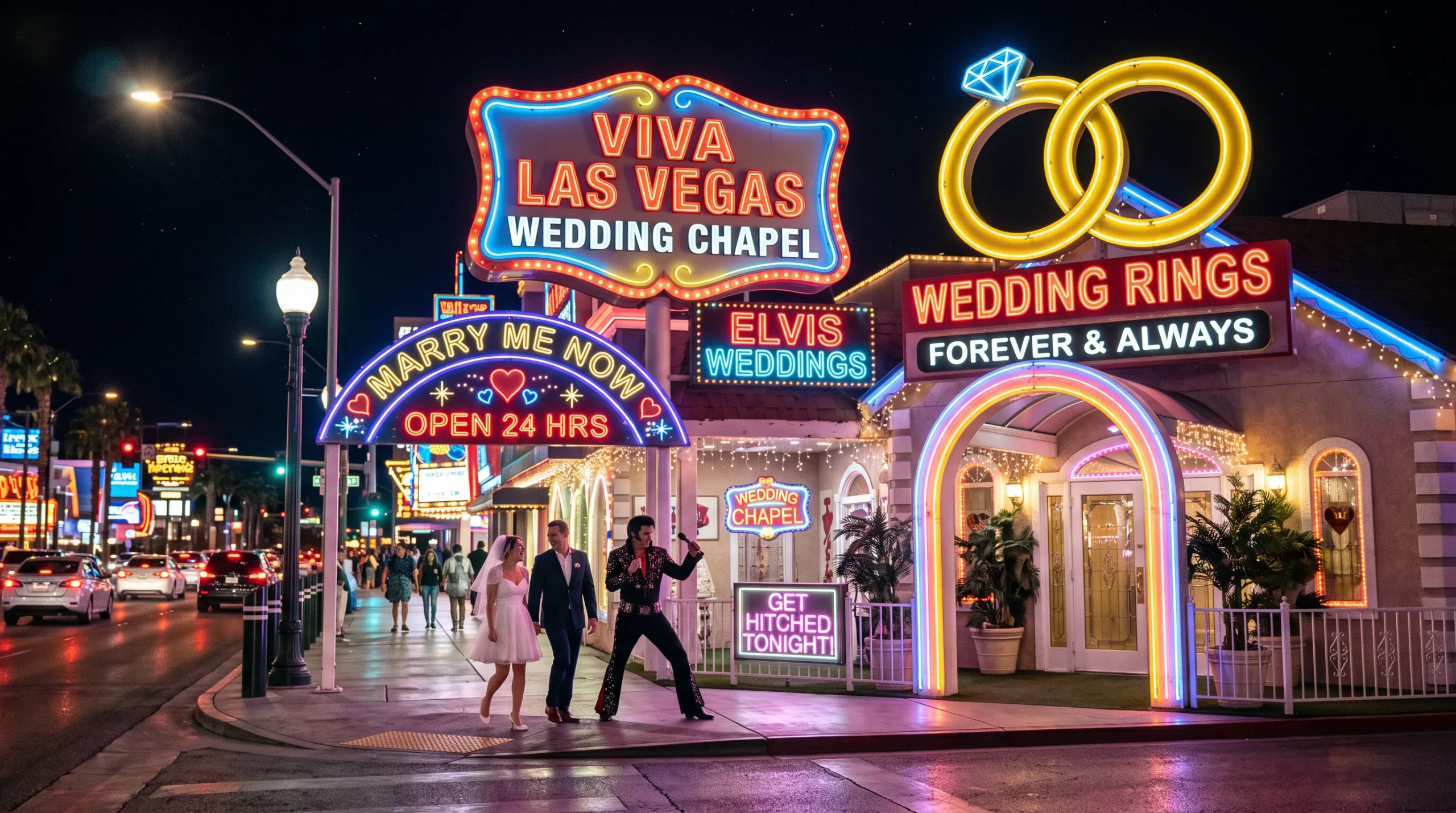
Las Vegas has a reputation for quick weddings, Elvis impersonators, drive-through chapels, and decisions made somewhere between the blackjack table and the last round of drinks.
That reputation creates an entertaining question:
Could you go to Las Vegas with a friend, drink too much, get married, and wake up the next morning realizing you are legally married?
The short answer is yes—under the right circumstances.
A Las Vegas wedding can be legally binding. However, simply stumbling into a chapel after a long night out does not automatically create a valid marriage. Nevada still requires a marriage license, an authorized officiant, a witness, and a ceremony.
Quick Answer
Yes, Las Vegas weddings are legally binding when the couple obtains a valid Nevada marriage license and completes a legal ceremony performed by an authorized officiant with at least one witness.
Nevada does not require a waiting period or blood test, so couples can obtain a license and marry on the same day. The license itself does not make you married. The marriage becomes official after the ceremony is performed and the completed marriage certificate is filed with the Clark County Clerk’s Office. (Clark County marriage requirements)
Can You Really Wake Up Married in Las Vegas?
It is possible, but there are several steps involved.
You and the other person would generally need to:
- Apply for a Nevada marriage license
- Appear together with government-issued identification
- Confirm that neither person is already married
- Have the ceremony performed by an authorized Nevada officiant
- Exchange vows in front of at least one witness
- Complete the marriage certificate process
So, technically, you would not become married just because you were drunk at a casino and jokingly called each other “husband” and “wife.”
There has to be an actual legal process behind it.
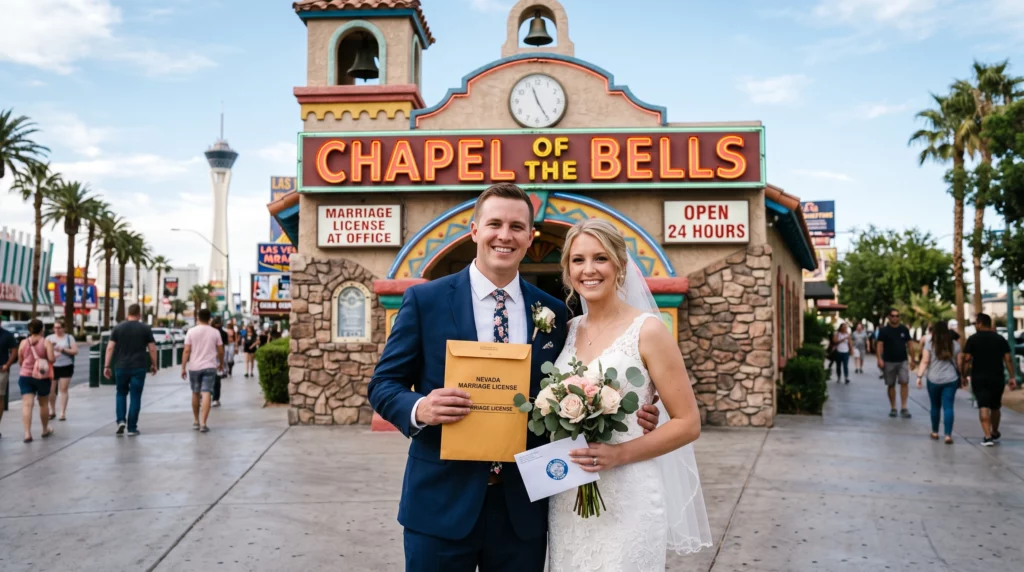
Las Vegas makes that process unusually convenient. The Marriage License Bureau is open seven days a week, including holidays, and Nevada does not impose a waiting period. That means a couple can apply for a license and have a ceremony later the same day. (Clark County Marriage License Bureau)
What Makes a Las Vegas Marriage Legal?
A valid Las Vegas marriage usually involves four important parts. The city may make weddings fast and convenient, but Nevada still requires a real legal process.
A Marriage License
Both people generally must be at least 18 years old, provide government-issued identification, and not currently be married to someone else.
The couple must apply for the license before the ceremony. A chapel cannot legally complete the marriage paperwork without the proper license.
An Authorized Officiant
The ceremony must be performed in Nevada by an officiant authorized to perform marriages.
That may be a minister, a judge, a commissioner of civil marriages, or another person who has received the required permission from Nevada authorities.
The person dressed as Elvis may be legally authorized—or may simply be there for the costume and entertainment. It is worth knowing which one before signing anything.
A Witness
Nevada requires someone other than the officiant to witness the couple exchanging vows. Many chapels can provide a witness if the couple arrives alone.
A wedding photographer, chapel employee, friend, or family member may serve as the witness, depending on the ceremony arrangements.
A Completed Marriage Certificate
After the ceremony, the officiant must complete and submit the marriage certificate to the Clark County Clerk’s Office. Clark County states that the officiant is legally responsible for delivering the completed certificate within ten calendar days.
The recorded marriage certificate becomes the official proof that the ceremony took place.
Does Being Drunk Make the Marriage Invalid?
Not automatically.
Being intoxicated does not instantly erase everything that happened during the night. If both people understood what they were doing, voluntarily agreed to marry, and completed the legal ceremony, the marriage may still be valid even if alcohol was involved.
The important question is not simply:
“Were we drinking?”
The more important question is:
“Did either person have enough understanding and capacity to genuinely consent to the marriage?”
Nevada courts can consider whether a person lacked the ability to understand what they were agreeing to. This is sometimes described as “want of understanding.” The Nevada courts explain that a marriage may be annulled when one spouse was incapable of agreeing to the marriage because they did not understand what they were doing. (Nevada Courts annulment information)
That is a much higher standard than simply waking up embarrassed or regretting the decision.
“We Were Drunk” Is Not an Automatic Annulment
A person cannot generally walk into court and say, “I had too many margaritas, so please erase the marriage.”
A judge may want evidence showing that the intoxication was severe enough to prevent genuine consent. Relevant evidence could include:
- How impaired the person appeared
- Whether they understood they were participating in a wedding
- Whether they could communicate clearly
- Witness statements
- Video from the ceremony
- Receipts or other evidence showing the timing and amount of alcohol consumed
- Whether the person continued living with or presenting themselves as married afterward
The details matter. A couple who had champagne before a ceremony is in a very different situation from someone who could not understand where they were or what was happening.
What If One Person Was Tricked?
Fraud or deception may also become relevant.
For example, a person might claim they agreed to a ceremony believing it was only a joke, a vow renewal, a staged photo opportunity, or a fake ceremony. Whether that argument succeeds depends on the facts and the available evidence.
A spontaneous decision is not necessarily fraud. Neither is changing your mind the next morning.
Las Vegas weddings are fast, but “fast” does not mean “automatically reversible.”
What Should You Do If You Think You Accidentally Got Married?
If you believe a real ceremony occurred, take the situation seriously.
Start by finding out whether:
- A Nevada marriage license was issued
- A ceremony actually took place
- The officiant was authorized
- The marriage certificate was submitted
- A recorded marriage certificate is available from Clark County
Do not assume that no paperwork means no marriage. Conversely, do not assume that a chapel photograph or novelty certificate proves a legal marriage.
If both people knowingly participated in a valid ceremony but later regret it, the usual solution may be divorce rather than annulment. An annulment requires a recognized legal basis, such as lack of capacity, fraud, duress, bigamy, or another qualifying issue.
Because the result can affect property, taxes, debts, insurance, inheritance, and future relationships, anyone facing a real situation should speak with a Nevada family-law attorney.
Can a Friend Marry You as a Joke?
Not casually.
A friend cannot simply pronounce two people married and create a legal marriage unless that person is properly authorized to perform the ceremony and the couple has completed the required licensing process.
A fake ceremony, staged chapel performance, or drunken joke usually is not enough by itself.
Still, if someone is presented with legal documents, believes the ceremony is real, signs paperwork, and the required steps are completed, the situation becomes much more complicated.
The Bottom Line
Las Vegas weddings are legally binding when the legal requirements are satisfied. The city’s quick marriage process makes same-day weddings easy, but it does not make marriage meaningless.
You can marry in Las Vegas without a waiting period. You can marry in a small chapel, at a resort, in a civil ceremony, or beside an Elvis impersonator. But there still needs to be a valid license, an authorized officiant, a witness, and genuine consent.
So if you wake up in Vegas wearing a wedding ring next to your friend, do not panic—but do not laugh it off either.
First, find out whether it was only a very expensive joke or an actual legal marriage.
This article provides general information, not legal advice. Nevada marriage and annulment questions can depend heavily on the specific facts.