

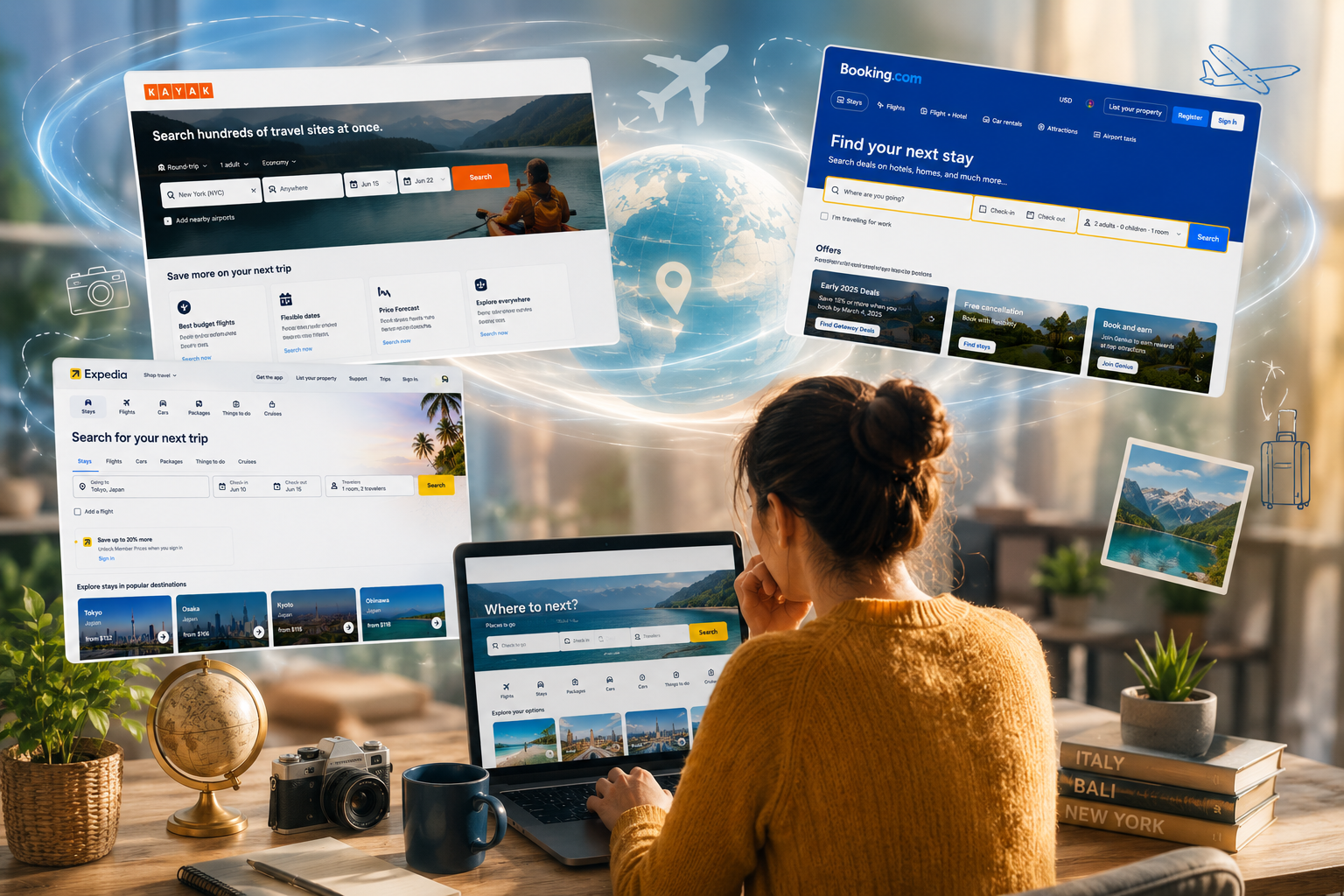
Quick Answer: The Best Apps and Websites for Budget Travelers at a Glance
If you just want the short version, here is how I would use each one:
- Best for comparing flight and hotel prices before you book: KAYAK
- Best for flexible hotel and apartment bookings: Booking.com
- Best for bundling flights, hotels, and cars in one place: Expedia
- Best for hotel-only travelers who want member prices: Hotels.com
- Best for reading reviews and double-checking cheap hotel deals: Tripadvisor
- Best for family trips, group travel, and whole-home rentals: Vrbo
- Best for tours, attraction tickets, and day trips: GetYourGuide
- Best for international hotel deals, especially in Asia: Agoda
How to stretch your travel budget without turning trip planning into a second job
There is a certain kind of travel advice that sounds wonderful in theory and slightly exhausting in real life.
It usually goes something like this: track fifteen fare calendars, compare nine hotel sites, set six price alerts, join every loyalty program on earth, and then maybe — if the travel gods are feeling generous — you will save $37.42 on a weekend trip to Nashville.
That is not really how most people want to travel.
Most of us want something simpler. We want to spend less, yes, but we also want to enjoy the trip planning process, or at least survive it without needing a nap and a spreadsheet intervention. We want to know which websites are actually worth opening, which apps are good for comparing prices, which ones are best for flexible hotel bookings, and which ones help you avoid paying too much for the fun part once you finally arrive.
That is where this guide comes in.
The truth is, budget travel is rarely about finding one perfect website. It is about using the right website at the right point in the trip-planning process. One site may be great for comparing flights. Another might be better for hotel deals. Another could save you money if you are traveling with family and need a vacation rental with a kitchen instead of two hotel rooms and a daily breakfast bill that quietly gets out of hand by day three.
So rather than pretend every platform does the same thing, I want to show you what each one is actually good at.
| Platform | Best For | Why Budget Travelers Use It | Main Watch-Out |
|---|---|---|---|
| KAYAK | Comparing flights, hotels, and rental cars | Great starting point for price alerts, airfare comparisons, flexible dates, and nearby airport searches. | You may book through another provider after comparing. |
| Booking.com | Hotels, apartments, and flexible stays | Strong filters for free cancellation, breakfast, kitchens, apartments, guesthouses, and neighborhood searches. | Always compare the final rate and cancellation terms. |
| Expedia | Vacation packages and all-in-one booking | Useful for bundling flights, hotels, rental cars, and earning One Key rewards. | Be careful with complicated flight bookings through third parties. |
| Hotels.com | Hotel-only deal hunting | Simple hotel-focused search with member pricing and One Key rewards. | Compare rewards value before booking only for loyalty points. |
| Tripadvisor | Reviews and hotel reality checks | Helpful for reading recent reviews, checking traveler photos, and avoiding bad cheap hotels. | Best used as a research tool, not your only booking source. |
| Agoda | International hotel deals | Especially useful for Asia and international destinations where rates may be competitive. | Double-check taxes, fees, and room details before booking. |
| Vrbo | Families, groups, and vacation rentals | Whole-home rentals can save money when splitting costs or using a kitchen. | Cleaning fees and service fees can change the real total. |
| GetYourGuide | Tours and attraction tickets | Good for comparing walking tours, day trips, attraction tickets, and skip-the-line options. | Cancellation policies vary by listing. |
In this guide, I am looking at eight major travel platforms that budget-conscious travelers use all the time:
- Booking.com
- Expedia
- Hotels.com
- Tripadvisor
- Vrbo
- KAYAK
- GetYourGuide
- Agoda
Some are best for flights. Some are stronger for hotels. Some shine once you are already at your destination and trying to book activities without blowing the rest of your budget on one skip-the-line ticket and a mediocre bus tour.
If you use them well, they can help you spend less, stay flexible, and plan smarter. And if you use them poorly? Well, a few of them can absolutely send you down a rabbit hole of “wait, why is this fee here?” or “why did I think booking a nonrefundable room two months in advance was a good idea?”
We will talk about that too.
And if you remember only one thing from this entire article, let it be this:
Budget travelers do not need one perfect travel app. They need a small toolkit.
Use a comparison tool to see the market. Use a booking platform that matches the kind of trip you are taking. Use reviews to avoid bad “deals.” Use rentals strategically when they actually save money. And always, always look at the final price before congratulating yourself.
That last part matters more than any loyalty badge ever will.
Why Budget Travelers Should Use More Than One Travel Website
I think one of the biggest mistakes budget travelers make is deciding too early that they are “a Booking.com person” or “an Expedia person” or “I always use Hotels.com because I’ve used it forever.”
I understand the instinct. Familiarity is comfortable. When you find a site you know how to navigate, it feels easier to stay there and do everything in one place. Sometimes that works. Sometimes it really does.
But it can also cost you money.
Here’s why: these platforms are not all trying to solve the same problem.
- KAYAK is strongest when you are still shopping and comparing.
- Booking.com is often strongest when you need lots of hotel and apartment choices with flexible filters.
- Vrbo makes more sense when you are traveling with kids, friends, or anyone who would benefit from a kitchen, laundry, and multiple bedrooms.
- Tripadvisor is what you open when a hotel looks suspiciously cheap and you need to find out if it is a hidden gem or just hiding something else.
- GetYourGuide comes in later, once the flights and hotel are handled and you want to book a few experiences without paying “I panicked and booked the first thing I saw” prices.
That is why I do not think of these sites as competitors so much as different tools in the same drawer.
And frankly, that is better for budget travel anyway. Because the goal is not just to spend less. The goal is to spend less without accidentally booking a terrible hotel, paying extra baggage fees you forgot to calculate, or locking yourself into a nonrefundable stay in a neighborhood you did not actually mean to stay in.
A cheaper trip is only a better trip if it still feels like a good trip once you get there.
The Best Apps and Websites for Budget Travelers
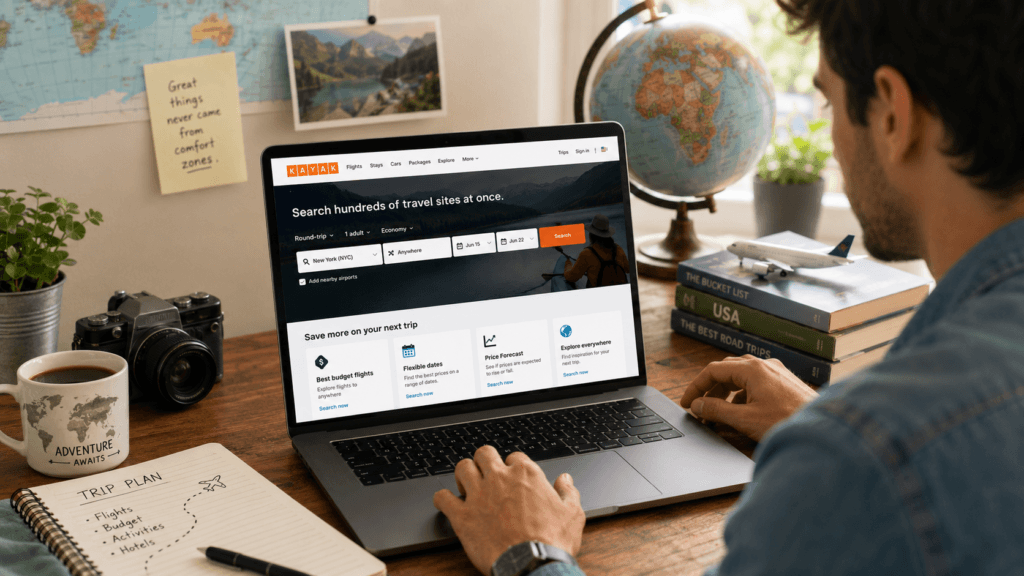
1) KAYAK
Best for Comparing Prices Before You Book Anything
If I were helping a friend plan a trip on a budget and they asked me where to start, KAYAK would probably be the first tab I’d tell them to open.
Not because I think it is the perfect place to book everything, but because it is one of the best places to start.
That distinction matters.
KAYAK is most useful when you are still in research mode. You know you want to go somewhere. You may even know your dates. But you are not ready to hit “Book now” yet because you want to understand the price landscape first. You want to know if your flight is expensive, if your hotel budget is realistic, if one airport is dramatically cheaper than another, or if shifting your trip by a day or two might save enough money to cover dinner somewhere fun.
That is where KAYAK earns its keep.
Use KAYAK to compare flight and hotel prices before you book.
Why KAYAK works so well for budget travelers
KAYAK is a travel search engine, which means it scans and compares prices across airlines, hotel sites, and online travel agencies rather than operating like just one booking platform with one set of rates. For budget travelers, that is useful because it gives you a broader look at what is out there before you commit to anything.
In practical terms, KAYAK is good at helping you answer questions like:
- Is this flight price normal or am I looking at a bad day to book?
- Is it cheaper to fly into a nearby airport?
- Is this hotel really a deal, or is another site showing it for less?
- Would I save more by staying in a different neighborhood?
- Is it worth waiting a few days before booking?
Those are budget-travel questions. They are not glamorous questions, but they are the questions that keep you from overspending in the first ten minutes of trip planning.
Where KAYAK saves the most money
I think KAYAK is especially useful for airfare, because airfare has a way of changing by the minute and making otherwise rational adults behave like stock traders. KAYAK’s price tracking tools and alerts can help you keep an eye on a route without hovering over it every hour like it personally insulted you.
It is also useful for hotel comparisons, especially if you are seeing the same property show up across multiple booking sites and you want a quick look at how those rates stack up.
For a budget traveler, KAYAK is less about loyalty and more about visibility. It helps you see the board before you make a move.
When I would use KAYAK
I would use KAYAK if:
- I am still comparing destinations or airports
- I want to see whether shifting dates lowers the fare
- I want to compare hotel prices across multiple platforms quickly
- I am trying to understand the market before I decide whether to book direct, use an OTA, or wait
What KAYAK does not do best
KAYAK is not the site I rely on for every final booking. Sometimes it will send you to the airline. Sometimes to a hotel site. Sometimes to another OTA. That is not a flaw. It is just the nature of a comparison platform.
Think of it as your trip planning scout. It goes out first, gathers the information, and helps you figure out where the real deal is.
Budget traveler tip for using KAYAK
Do not use KAYAK as your only step. Use it as your first step.
Search the flight or hotel. See what the pricing looks like. Then click through and compare the final booking details on the site that actually has the rate. That last part matters because the cheapest number in a search result is not always the cheapest total once bags, taxes, cancellation terms, or weird little booking quirks start showing up.
KAYAK helps you find the door. It is still your job to look through it before walking in.

2) Booking.com
Best for Flexible Hotel and Apartment Bookings
If KAYAK is where I start, Booking.com is one of the places I go when I’m ready to get serious about where I’m actually going to stay.
And if you are the kind of traveler who likes options — hotels, apartments, guesthouses, small inns, maybe even a place with a tiny balcony and a coffee maker that looks like it survived the Clinton administration — Booking.com can be incredibly useful.
It is one of the biggest accommodation booking platforms in the world, and the biggest strength of Booking.com is not just that it has a lot of listings. It is that it has a lot of different kinds of listings. For budget travelers, that matters because the cheapest smart option is not always a hotel.
Sometimes it is an apartment with a kitchen.
Sometimes it is a guesthouse near the train station.
Sometimes it is a simple room in a smaller property that doesn’t belong to a big chain but happens to be exactly what you need.
Booking.com is very good at surfacing those options.
Search flexible hotels, apartments, and guesthouses on Booking.com.
Why Booking.com works so well for budget travelers
The best thing about Booking.com, in my opinion, is that it is strong at the messy middle of trip planning — that stage where you are not just looking for a hotel, you are trying to find the right type of stay at the right price, in the right neighborhood, with cancellation terms you can live with.
It is especially good if you care about things like:
- Free cancellation
- Pay later or reserve now, pay later options
- Apartments and aparthotels
- Breakfast included
- Neighborhood filtering
- Guest ratings
- Kitchen or laundry access
- Family room availability
That sounds basic, but those filters are often what make the difference between a trip that stays on budget and a trip that quietly drains money in other ways.
A room without breakfast may be cheaper on paper, but if you’re feeding four people every morning in a tourist-heavy neighborhood, the “cheaper” room may stop being cheaper pretty quickly. A place without a mini fridge may not matter for one night, but on a five-night trip it can push you into eating every meal out whether you want to or not.
Budget travel is not just about the nightly rate. It is about the total cost of staying there.
Why I like Booking.com for apartments and smaller stays
One thing Booking.com does particularly well is bridge the space between traditional hotels and short-term rentals. That makes it useful for travelers who are not sure they want a full vacation rental, but also do not want a standard hotel room if they can avoid it.
If I were planning a city trip and wanted a small apartment with a kitchenette, or a simple studio near public transit, or a guesthouse with strong reviews and a more local feel, Booking.com is one of the first places I’d check.
This is especially true in Europe and in many international cities, where Booking.com often feels very comfortable on the hotel-and-apartment side of travel.
The Genius program: useful, but not magic
Booking.com’s Genius program is one of the more visible member programs in online travel. Once you sign in and book through the platform, you can unlock Genius discounts and perks at participating properties.
That can absolutely be helpful for budget travelers. A 10% discount here, maybe breakfast included there, sometimes an upgrade or a better cancellation setup — those things add up.
But I would not treat the Genius badge like a guarantee that you are seeing the lowest possible price.
Sometimes it is a real bargain. Sometimes it is simply a decent rate with a nice blue label next to it. I say that gently, but I say it because I think budget travelers need honesty more than hype. A “member deal” is still worth comparing against the hotel’s own website and at least one other booking platform before you check out.
When I would use Booking.com
I would open Booking.com when:
- I want a hotel or apartment and haven’t decided which yet
- I care about flexible cancellation
- I am traveling internationally and want lots of smaller lodging options
- I need to compare location, amenities, and guest reviews quickly
- I want a stay with a kitchen, breakfast, or laundry access to help control costs
What I would double-check before booking
This is true on every OTA, but it is especially worth saying here:
Read the room type carefully. Read the cancellation terms carefully. Read the taxes and fees carefully.
A “great” deal can look less great when you realize:
- it is a shared bathroom situation you somehow missed,
- the breakfast is not actually included in the rate you clicked,
- the room is nonrefundable,
- or the apartment is on the edge of town and not the charming neighborhood you thought you found.
None of those things make Booking.com bad. They just make it a platform where the details matter.
My take
For budget travelers who want flexibility and a wide range of hotel, apartment, and guesthouse options, Booking.com is one of the most useful lodging platforms out there. It is not the only place I would check, but it is absolutely one of the core tabs in my travel-planning routine.

3) Expedia
Best for Travelers Who Want Flights, Hotels, and Cars in One Place
There are travelers who love the thrill of comparing every leg of a trip separately. They will book the flight on one site, the hotel on another, the rental car somewhere else, and then spend the next forty minutes explaining to you why this saved them $63 and “a lot of flexibility.”
And honestly? Sometimes they are right.
But there is another kind of traveler — and I think this is a very reasonable kind of traveler — who wants one site that can handle the whole trip. Flight, hotel, car, maybe even activities. One login. One account. One loyalty program. One place to keep track of things.
That is where Expedia makes a lot of sense.
Why Expedia is useful for budget travelers
Expedia’s biggest advantage is not that it is always the absolute cheapest on every single piece of a trip. It is that it can be cost-effective and convenient at the same time, especially when you are booking multiple travel components together.
If you are booking:
- a flight and a hotel,
- a hotel and a rental car,
- or a full trip package where you want to see the combined price in one place,
Expedia is worth checking.
That is particularly true for budget travelers who value bundling. Package deals can sometimes lower the total cost enough to matter, especially if you were going to book those pieces anyway. The savings are not guaranteed, and I would never tell anyone to book a package just because the word “deal” is attached to it. But if you are planning a pretty standard trip and you want the convenience of handling it all in one place, Expedia can be a very practical option.
Check Expedia for flight and hotel package deals.
The appeal of Expedia is really about trip assembly
I think of Expedia as a trip assembly tool. It is less romantic than that probably sounds, but it is accurate.
You can sit down and say:
- I need flights for these dates
- I want a hotel in this neighborhood
- I may need a rental car for two days
- I would like to earn rewards on all of it if possible
And Expedia is built to handle that kind of traveler.
For someone planning a budget trip who doesn’t want to open seven different sites and stitch the whole thing together by hand, that can be worth a lot.
Expedia and One Key rewards
Expedia is part of the One Key ecosystem, along with Hotels.com and Vrbo. That means rewards can carry across those platforms, which is actually useful if you do not travel in one very specific way every single time.
Maybe one trip is a hotel weekend.
Maybe the next is a family rental through Vrbo.
Maybe the next is a flight-plus-hotel city break.
For travelers who bounce between those kinds of trips, having one rewards structure instead of three separate accounts is a real advantage.
I do not think rewards should be the only reason you choose a travel platform, but if you already use Expedia, Hotels.com, or Vrbo with some regularity, it is nice when those bookings are at least talking to each other.
Where Expedia saves the most money
Expedia tends to make the most sense for budget travelers when:
- you are booking multiple trip components
- you want to compare package pricing
- you like seeing flights, hotels, and cars together
- you want one place to manage a relatively straightforward trip
It can also be useful for hotel shopping on its own, but I think the real value of Expedia shows up when it is doing more than one job for you.
My caution with Expedia: flights require a little more care
This is where I think it helps to be honest.
I am perfectly comfortable recommending Expedia as a tool for hotel bookings and package shopping. But with flights, I would slow down and make sure you understand what you are booking and who will be responsible if something changes.
This is not an Expedia-only issue. It is a third-party flight booking issue in general.
If an airline changes a schedule, cancels a segment, or you need to make a complicated adjustment, things can get a little more annoying when there is a middleman involved. That does not mean you should never book flights through Expedia. It just means I would do it more confidently for simple itineraries than for very complicated ones.
A nonstop roundtrip domestic flight? Fine, maybe.
A multi-country itinerary with tight connections and a lot of moving parts? I’d think a little harder.
When I would use Expedia
I would use Expedia when:
- I want to compare a flight + hotel package
- I want one platform for a fairly straightforward trip
- I want to see whether bundling lowers the overall price
- I already use One Key and want the rewards credit
- I am not in the mood to play travel-booking whack-a-mole across six tabs
My take
For budget travelers who want to book multiple parts of a trip in one place, Expedia is one of the strongest options in this entire group. It is not always the cheapest line item by line item, but that is not really the point. Its strength is convenience plus package value, and for a lot of travelers that combination is worth a lot.
4) Hotels.com
Best for Hotel-Only Travelers Who Want a Simple Deal-Focused Search
There are trips where I want an apartment. There are trips where a rental house makes sense. There are trips where I want to compare everything under the sun.
And then there are trips where I just want a hotel.
A normal hotel. In a decent location. At a fair price. With a clean room, reasonable reviews, and ideally a cancellation policy that doesn’t feel like a legal thriller.
That is where Hotels.com still makes sense.
Compare hotel-only deals on Hotels.com.
What Hotels.com does well
Hotels.com is, unsurprisingly, hotel-focused. That sounds obvious, but it actually changes the browsing experience in a nice way. When you know you are not shopping for a vacation rental, not building a flight package, and not looking for an apartment with a washing machine and exposed brick, there is something refreshing about a site that is mostly about finding a hotel and moving on with your day.
Hotels.com is useful for budget travelers who:
- mostly stay in hotels
- like browsing member prices
- want a simpler hotel-first search experience
- already use the Expedia/One Key ecosystem
It is not flashy, and I do not mean that as criticism. Some trips do not need flashy. Some trips need “find me a good hotel near downtown and do not make this harder than it needs to be.”
Member pricing can be worthwhile
Hotels.com has long appealed to travelers who like a deal-oriented hotel search, and it still offers member pricing and participates in the One Key rewards program.
If you are the kind of traveler who books several hotel stays a year, that can be useful. Not life-changing, maybe, but useful.
The real value depends on how often you travel and whether you are also using Expedia or Vrbo. If you are bouncing between those platforms anyway, it is nice to have one rewards structure rather than a collection of half-finished loyalty accounts you forgot existed until a password reset email arrives at 11:30 at night.
Why Hotels.com works for budget travelers
The biggest thing Hotels.com offers budget travelers is focus.
You are not there to build an entire dream itinerary. You are there to find a room at a price you can live with. If that sounds reductive, I do not mean it to. I actually think there is something wonderful about a tool that knows what it is for.
Hotels.com is often a good second or third tab when I am comparing hotel rates. If Booking.com has the room but Hotels.com has a similar price and I want to keep the booking inside the One Key ecosystem, I will absolutely look at it.
The thing longtime users still talk about
If you have been booking hotels online for years, you may remember the older version of Hotels.com rewards. A lot of longtime travelers do, and many of them still compare the current One Key structure to that old “collect nights toward a reward night” setup.
That doesn’t make Hotels.com bad now. It just means some longtime users feel the value proposition changed.
For a new or occasional traveler, that may not matter much. For someone who used to book heavily through Hotels.com because they loved the old rewards setup, it might matter more. I think that is worth acknowledging because budget travel is not only about today’s price — it is also about how much value a platform gives you over time.
When I would use Hotels.com
I would use Hotels.com when:
- I know I want a hotel, not an apartment or vacation rental
- I want to compare member pricing with Booking.com and Expedia
- I already use One Key and want to keep the booking in that system
- I want a hotel-first interface that does not try to turn my weekend trip into a life event
My take
Hotels.com is not the flashiest travel site in this group, but for hotel-only budget travelers, it is still very useful. I would not use it in isolation, but I would absolutely keep it in the comparison rotation.
5) Tripadvisor
Best for Reviews, Reality Checks, and Avoiding Bad “Deals”
If I had to choose the one travel website on this list that has saved people from more regrettable hotel decisions than almost any other, I think it might be Tripadvisor.
Not because it always has the cheapest rate. It usually isn’t the point.
Tripadvisor’s superpower is that it helps you answer one of the most important budget-travel questions of all:
Is this actually a good deal, or is it just a cheap room with a very good photographer?
That is not a small question.
Budget travelers are often shopping at the edge of compromise. Maybe the hotel is farther out. Maybe it is older. Maybe it is a smaller room, a more basic property, a less glamorous neighborhood, or a lower star rating than what you would choose if money were no object.
That is fine. I think some of the best travel decisions come from smart compromise.
But there is a difference between “simple and affordable” and “I cannot believe I paid money to stay here.” Tripadvisor helps you find that line.
Read recent hotel reviews on Tripadvisor before booking.
Why Tripadvisor matters for budget travelers
When you are trying to save money on accommodations, the temptation is to sort by price and get a little too excited when you see something that looks dramatically cheaper than everything around it.
That is exactly when you should open Tripadvisor.
Tripadvisor is where I go to check:
- whether the rooms are actually clean
- whether the neighborhood is convenient
- whether the walls are made of tissue paper
- whether the “walkable location” involves crossing a six-lane road and a parking lot apocalypse
- whether breakfast is worth counting on
- whether “recently renovated” is a phrase being used creatively
It is also useful for looking at traveler photos, which can be much more revealing than the polished marketing images on a hotel booking page.
It is not just about hotels
Tripadvisor can also help with:
- restaurant research
- attraction reviews
- neighborhood planning
- comparing the overall feel of different areas before you book
For budget travelers, this matters because a cheap hotel in the wrong location can create extra transportation costs, wasted time, and a whole lot of frustration. A place that is technically affordable but requires a rideshare every time you want to leave it may not be much of a bargain.
Why I use Tripadvisor with other sites, not instead of them
I do not think of Tripadvisor as my main booking engine. I think of it as my reality check.
Maybe I found a hotel on Booking.com.
Maybe Expedia has a package that looks good.
Maybe Agoda surfaced a rate that seems unusually low.
Before I commit, I want to know what actual travelers are saying. I want to know if there is a reason this property is $60 less per night than the one across the street.
Sometimes the answer is great news: maybe it is simply a smaller hotel with fewer amenities and an excellent location. Wonderful.
Other times the answer is that the air conditioning sounds like a tractor and the bathroom has a personality disorder.
Tripadvisor helps you sort that out before it becomes your problem.
When I would use Tripadvisor
I would use Tripadvisor when:
- I found a hotel on another site and want to verify it
- I am choosing between two similarly priced properties
- I want to understand a neighborhood before booking
- I need to know if the “cheap deal” is too good to be true
- I want traveler photos and detailed review context
Budget traveler tip for using Tripadvisor
Do not just look at the star rating. Read recent reviews and look for patterns.
One complaint about noise? That may be one traveler.
Ten reviews in three months mentioning mold, surprise fees, or “the pictures must be from 2017”? That is a pattern.
Also pay attention to the kinds of complaints that matter to you. Some travelers will leave a furious review because a hotel did not have a rooftop pool, and that may be deeply irrelevant to your budget-conscious city break. But if multiple people mention safety, cleanliness, or impossible parking, that is worth your attention.
My take
Tripadvisor is not the most exciting site in this lineup, but it may be one of the most useful. For budget travelers, it is the difference between finding a cheap room and finding a cheap room you will not regret.
That is a big difference.
6) Agoda
Best for International Hotel Deals, Especially in Asia
Agoda is one of those sites that some travelers use constantly and others barely think about until they are planning a trip to Asia and suddenly discover that, oh, right, Agoda is very much a thing and maybe should have been open in a browser tab about thirty minutes ago.
If your travel is mostly domestic U.S. road trips, Agoda may not be the first platform that comes to mind. But if you are planning international travel — especially in Asia — it deserves your attention.
Why Agoda is worth checking
Agoda is a major accommodation platform with a particularly strong presence in the Asia-Pacific market. For budget travelers, that matters because hotel pricing can vary significantly across platforms depending on the region, the property type, and the way rates are being distributed.
In plain English: sometimes Agoda has the better price.
Not always. I wish travel were that simple. But often enough that I think it is worth checking, especially for international itineraries.
Where Agoda makes the most sense
Agoda is especially useful for:
- trips to Southeast Asia
- Japan, South Korea, and other major Asia-Pacific destinations
- international city stays where you want to compare another OTA before booking
- travelers who are comfortable checking multiple hotel platforms before making a decision
I would not necessarily tell someone planning a quick domestic overnight stop in Ohio that Agoda needs to be the first thing they do. But if you are planning a longer international trip and trying to keep hotel costs under control, I absolutely think it belongs in the mix.
Agoda and deal hunting
Agoda tends to appeal to deal-minded travelers because it frequently promotes:
- app-only discounts
- member pricing
- flash deals
- VIP or loyalty perks on some properties
That does not mean every Agoda listing is a hidden treasure. It does mean the platform is built in a way that encourages comparison shopping and reward-minded browsing, which is very much in line with how budget travelers tend to think.
What I like Agoda for
I like Agoda as the “one more smart check” before I book an international hotel.
If I found a place on Booking.com and it looks good, I may still look at Agoda to see if:
- the same hotel is listed for less,
- a different room category is priced more favorably,
- or another nearby property shows up that did not appear prominently on the other sites.
That is often where the value is. Agoda may not replace the rest of your search, but it can improve it.
What I would double-check on Agoda
As with any OTA, read the details. Especially:
- cancellation policy
- whether taxes and fees are fully included
- breakfast details
- room type
- bed configuration
- and any notes about prepayment
International bookings can already involve a little more uncertainty simply because you may be dealing with different property styles, languages, and rate rules. The last thing you want is to save money on paper and then realize you booked the one room in the building with no window and a “city view” that apparently exists only as a concept.
When I would use Agoda
I would use Agoda when:
- I am booking hotels in Asia or nearby international markets
- I want one more rate comparison before committing
- I am looking for app/member discounts
- I am trying to keep hotel costs down on a multi-city international trip
My take
Agoda is not a must-use site for every single trip, but for international budget travelers — especially those heading to Asia — it can be extremely valuable. I would not ignore it, and I definitely would not leave it out of an article about budget travel tools.
7) Vrbo
Best for Families, Groups, and Trips Where Space Saves Money
There is a moment in some trips when the traditional hotel model simply stops making financial sense.
Maybe you are traveling with kids.
Maybe it is two couples and a friend.
Maybe it is a week at the beach, a family reunion, a lake trip, or a longer stay where you know full well that eating every meal out is going to devour your budget before the vacation is half over.
That is where Vrbo can become the smartest move in the whole trip.
Why Vrbo belongs in a budget travel conversation
Vrbo is a vacation rental platform focused on whole-home stays. That is an important distinction. If you are looking for a spare room in someone’s apartment, that is not really Vrbo’s lane. Vrbo is for travelers who want an entire place — a condo, a cabin, a beach house, a townhome, a cottage, something with walls and a door and ideally a refrigerator full of your own groceries instead of a minibar charging you $7 for peanuts.
For budget travelers, Vrbo is not about being “cheap.” It is about being cost-effective when the math works in your favor.
And the math often works in your favor when:
- you are splitting the cost among several people
- you need multiple bedrooms
- you want a kitchen
- you want laundry
- you are staying long enough for space and self-catering to matter
Why a rental can save money even if the nightly rate looks higher
This is where people sometimes get tripped up.
A Vrbo rental may look more expensive than a hotel at first glance. But that comparison can be misleading if you are comparing:
- one rental vs. two hotel rooms
- a rental with a kitchen vs. a hotel where every breakfast, snack, and late-night “we’re all hungry again” moment gets outsourced to restaurants
- a seven-night stay with laundry access vs. a hotel where you either pack more or pay for laundry service
Budget travel is about total trip cost, not just the number attached to one night of lodging.
If a rental lets a family cook breakfast, pack lunches, split bedrooms, and avoid booking multiple hotel rooms, it can be a fantastic value. The same is true for group trips where everyone would rather have a living room and a kitchen than four separate rooms and a lobby vending machine.
Where Vrbo makes the most sense
I think Vrbo is especially useful for:
- beach trips
- mountain trips
- lake vacations
- national park gateway towns
- ski weekends
- family travel
- multi-generational travel
- friend-group trips
- longer stays
It can also make sense in destinations where hotel inventory is limited or unusually expensive.
The catch: fees matter here, maybe more than anywhere else
If there is one thing I would tell budget travelers about Vrbo, it is this:
Never judge a vacation rental by the nightly rate alone. Ever.
With rentals, the total price matters even more than usual because you may be dealing with:
- cleaning fees
- service fees
- pet fees
- parking details
- cancellation rules
- house rules
- security deposit language
- minimum stay requirements
A rental that looks like a bargain at first glance can become much less charming once the full total appears. That does not mean Vrbo is a bad deal. It means Vrbo is a platform where you absolutely must click through to the total before deciding whether you found something wonderful.
Why I still like Vrbo for budget travelers
Because when it works, it really works.
There is something deeply budget-friendly about:
- making breakfast in pajamas before heading out for the day
- storing leftovers
- washing sandy swimsuits or hiking clothes
- putting kids to bed in one room while adults stay up in another
- parking in a driveway instead of paying hotel parking rates
- not needing two or three separate hotel rooms
That is real savings, but it is also comfort. And I think that matters. A budget trip should still feel like a trip, not a punishment.
When I would use Vrbo
I would use Vrbo when:
- I’m traveling with family or a group
- I need more than one bedroom
- I want a kitchen and laundry access
- I’m staying long enough for “living there a little” to be cheaper than hotel life
- the cost of multiple hotel rooms starts to look ridiculous
My take
Vrbo is not the answer to every budget trip, but for family travel and group travel, it can be one of the smartest money-saving tools in this entire lineup. Just make sure you compare the total price, not the nightly rate that lured you in.
8) GetYourGuide
Best for Tours, Attraction Tickets, and Keeping Activity Costs Under Control
There is a point in trip planning where most budget travelers stop thinking about the “big” expenses — the flight, the hotel, the rental car — and then accidentally spend far too much on the little ones.
A museum pass here.
A food tour there.
A skip-the-line ticket because you do not want to waste half your afternoon in line.
A day trip because you are already there and it sounds fun and somehow now you have spent the equivalent of two hotel nights on activities.
This is why GetYourGuide belongs in a budget travel conversation.
Not because tours and activities are the first place I would tell someone to save money. Honestly, they are not. Sometimes the experience is the trip. Sometimes the thing worth spending on is the thing you came to do.
But if you are going to book activities, it helps to do it thoughtfully. GetYourGuide can help with that.
What GetYourGuide is actually good at
GetYourGuide is a platform for:
- attraction tickets
- guided tours
- walking tours
- day trips
- transfers
- food and cultural experiences
- skip-the-line access in some destinations
- city sightseeing activities in one place
It is not competing with Booking.com or Expedia on hotels. It is solving a different problem: how to find and compare things to do once you know where you are going.
For budget travelers, that matters because activities can be sneaky. A trip can look affordable on paper until you realize every museum, ferry, tour, and transportation add-on is coming out of the same budget.
Why GetYourGuide is useful for budget travelers
I like GetYourGuide for two main reasons.
First, it puts a lot of activity options in one place, which makes comparison easier. Instead of opening five attraction websites and three local tour operators, you can at least start by seeing what is available, what the pricing looks like, and how travelers have rated it.
Second, it can help you avoid the “book in a panic on arrival” problem.
That is a very real travel problem. You land somewhere exciting, realize the one attraction you really wanted to do is sold out or nearly sold out, and now you are booking the first thing you see because you do not want to waste the day.
GetYourGuide is helpful because it lets you book a few key experiences in advance while still keeping the rest of your trip flexible.
Budget travelers do not need to book everything
This is important.
I am not suggesting that a budget traveler should pre-book every waking hour of a trip. That sounds tiring. Some of the best travel moments happen when you leave room for wandering, for changing your mind, for finding the café that wasn’t on the list.
But I do think it can be smart to use GetYourGuide for:
- one or two major attractions you know you want
- timed-entry experiences that might sell out
- day trips where transportation is included
- walking tours that help orient you in a new city
- activities where comparing options in one place saves time and money
The real budget question with tours is value, not just price
A cheap activity is not automatically a good value, just like an expensive activity is not automatically overpriced.
A $12 walking tour that helps you understand a city and gives you a great first afternoon? Fantastic.
A $110 “skip the line” experience that turns out to be mostly waiting in a different line? Less fantastic.
So when using GetYourGuide, I would look at:
- how long the experience actually lasts
- what is included
- whether transportation is included
- whether meals, entrance fees, or equipment are included
- how recent the reviews are
- the cancellation policy
That last one matters. Many activities on major platforms offer flexible cancellation windows, which can be very useful if your plans change, but I would still read the listing carefully instead of assuming every booking works the same way.
When I would use GetYourGuide
I would use GetYourGuide when:
- I want to compare tours or attraction tickets in one place
- I want to lock in one or two must-do experiences before arrival
- I’m visiting a city with timed-entry museums or popular attractions
- I want a day trip without piecing together transportation myself
- I’m trying to keep the activities budget under control instead of improvising my way into overspending
My take
GetYourGuide is not a flight app or a hotel site, but it absolutely belongs in a budget traveler’s toolkit. It helps you spend your activity budget more intentionally, which is often the difference between “we did a lot” and “we did a lot and now we’re eating granola bars for dinner.”
The Smarter Way to Use These Sites Together
Now that we have gone through each platform, I think the most helpful thing I can do is show you how I would actually use them together for a real budget trip.
Because that, to me, is where the value really is.
You do not need to pick one winner and pledge your loyalty like this is a reality show. You just need a simple process.
Step 1: Start with KAYAK
Use KAYAK to compare:
- flight prices
- nearby airports
- hotel price ranges
- rough timing for when to book
This is your research stage. You are not committing yet. You are learning what the trip is likely to cost and where the pressure points are.
Step 2: Compare lodging on Booking.com, Expedia, Hotels.com, and Agoda
Once you know your destination and dates, start comparing actual lodging options.
- Use Booking.com for hotel/apartment flexibility and lots of inventory.
- Use Expedia if you are also pricing a flight + hotel package.
- Use Hotels.com if you want a clean hotel-first search and One Key member pricing.
- Use Agoda if the trip is international, especially in Asia, or you simply want one more hotel comparison before you book.
Step 3: If traveling with family or a group, check Vrbo
If the trip involves multiple people, longer stays, or the need for a kitchen and extra space, compare the total cost of a Vrbo against the total cost of hotel rooms.
Sometimes the rental wins by a mile.
Sometimes it does not.
But it is worth checking before you assume the hotel is the cheaper option.
Step 4: Use Tripadvisor to verify the “deal”
Before booking your stay, open Tripadvisor and ask the most important question in budget travel:
Is this place actually worth it?
Read the reviews. Look at traveler photos. Pay attention to recent complaints and recurring problems.
Step 5: Use GetYourGuide for the experiences you actually care about
Once your flight and stay are handled, think about what you truly want to do.
Not everything. Just the things that would be disappointing to miss.
Use GetYourGuide to compare:
- attraction tickets
- walking tours
- day trips
- skip-the-line options
- local experiences
That gives you a way to budget for activities before you arrive instead of discovering too late that the “cheap” trip still has $300 worth of admissions attached to it.
My Best Budget Travel Tips for Using Booking Sites Without Getting Burned
There is a difference between using budget travel tools and using them well. So before we wrap this up, I want to leave you with a few habits that make a very real difference.
1) Always compare the final total, not the teaser price
This sounds obvious until you realize how often travelers — all of us, honestly — get distracted by the first price they see.
Look at:
- taxes
- service fees
- cleaning fees
- resort fees
- parking
- breakfast costs
- cancellation terms
The cheapest nightly rate is not always the cheapest trip.
2) Be suspicious of “too cheap”
I am not saying every bargain is fake. Some are real. Some are wonderful.
But if one hotel is dramatically cheaper than everything around it, pause. Open Tripadvisor. Read recent reviews. Make sure you are not looking at a room with a hidden catch, a bad location, or a property that has been photographed with unusual optimism.
3) Flexible cancellation has value
A refundable room may cost a little more upfront, but flexibility can be worth a lot if:
- airfare changes
- plans shift
- you are booking far in advance
- you are still comparing neighborhoods or trip dates
Budget travel is not just about the cheapest option. Sometimes it is about the cheapest option you can still escape from.
4) Kitchens are a budget feature
A kitchen is not just a nice amenity. It is a travel budget strategy.
Even if you only use it for:
- breakfast
- coffee
- snacks
- one easy dinner
- storing leftovers
it can save more than people expect.
5) Read the room description, not just the hotel description
The hotel may be lovely. Your room may be the tiny one behind the elevator with no view and a “compact bathroom” that requires emotional resilience.
Read the actual room category carefully.
6) Consider location as part of the budget
A cheaper hotel far from everything may cost you more in:
- taxis
- transit
- time
- convenience
- frustration
Sometimes the slightly more expensive hotel in a better location is the smarter budget choice.
7) Do not let loyalty points make bad decisions for you
Rewards are nice. I like rewards. I am not above feeling pleased with myself over a member discount.
But if a better hotel, better location, or significantly better price is available elsewhere, do not force yourself into a weaker booking just because your account says you are “Gold” or “Genius” or “Preferred Traveler Plus Ultra Diamond Deluxe.”
A badge is not a travel strategy.
Which Site Is Best for Your Type of Budget Trip?
To make this even simpler, here is how I would match the platform to the trip.
If you’re planning a quick city break
Start with KAYAK for flights, then check Booking.com and Hotels.com for the stay. Use Tripadvisor to confirm the hotel and GetYourGuide if there is one or two attractions you know you want.
If you’re planning a family beach trip
Compare Vrbo against the cost of hotel rooms. Use Booking.com too, because aparthotels and apartment-style stays can surprise you. Use Tripadvisor for location and cleanliness checks.
If you’re planning an international trip
Start with KAYAK, then compare Booking.com, Agoda, and Expedia for hotels. If the trip includes multiple cities or a package opportunity, Expedia may be especially worth checking.
If you’re planning a flight + hotel getaway and want it all in one place
Check Expedia first, especially for package pricing. Then compare the hotel portion against Booking.com or Hotels.com to make sure the convenience is still worth the cost.
If you’re traveling with friends
Check Vrbo before assuming multiple hotel rooms are the cheapest answer. A whole rental with a kitchen and shared living space can save money and make the trip better.
If you already found a cheap hotel and just need to know if it’s a mistake
Open Tripadvisor and start reading.
Final Thoughts: Use the Right Tool, Spend Less, Travel Better
If there is one thing I hope this guide does, it is take some of the pressure out of “budget travel.”
Because budget travel is often framed as if it requires either extraordinary discipline or a part-time hobby in airfare analysis. In reality, it usually comes down to something much simpler: using the right tools in the right order.
Use KAYAK when you want to compare prices and understand the market.
Use Booking.com when you want lots of flexible hotel and apartment options.
Use Expedia when you want to bundle a trip and keep the moving parts in one place.
Use Hotels.com when you want a straightforward hotel-focused search.
Use Tripadvisor to make sure your “great deal” is not attached to a terrible stay.
Use Agoda when you are booking internationally and want one more smart hotel comparison.
Use Vrbo when space, kitchens, and shared costs can save you real money.
Use GetYourGuide to keep activities organized and affordable instead of improvising your way into overspending.
You do not need one perfect website.
You need a small travel toolkit, a little patience, and the willingness to click past the first shiny price tag long enough to see what the trip actually costs.
Do that, and you do not just save money. You travel better.
And I think that is the point.
FAQ: Best Apps and Websites for Budget Travelers
What is the best website for cheap travel overall?
There is no single best website for every part of a trip. KAYAK is great for comparing prices, Booking.com is strong for flexible lodging, Expedia works well for packages, Vrbo can save money for groups, and Tripadvisor helps you avoid bad hotel deals.
Is Booking.com good for budget travel?
Yes. Booking.com is useful for budget travelers because it offers hotels, apartments, guesthouses, free cancellation filters, breakfast filters, and a wide range of lodging options in many destinations.
Is Expedia cheaper than Booking.com?
Sometimes Expedia is cheaper, especially for flight and hotel packages. Booking.com may be better for standalone hotel, apartment, or guesthouse bookings. It is smart to compare both before booking.
Is Vrbo cheaper than a hotel?
Vrbo can be cheaper than a hotel for families, groups, and longer stays, especially when travelers split the cost or use the kitchen to save on meals. Always compare the full total after fees.
Is Agoda good for international travel?
Yes. Agoda is especially useful for international hotel searches and is often worth checking for Asia-Pacific destinations. Travelers should still compare the final price and read the booking terms carefully.
Should I book tours and attractions in advance?
It can be smart to book major tours, attraction tickets, or day trips in advance, especially for popular destinations. GetYourGuide is useful for comparing options, prices, reviews, and cancellation policies.
Is Tripadvisor good for budget travelers?
Tripadvisor is very useful for budget travelers because it helps you check reviews, traveler photos, location details, and recent complaints before booking a cheap hotel or activity.
How many travel websites should I check before booking?
Most travelers do not need to check every site. A smart approach is to compare prices on KAYAK, check hotels on two or three booking sites, read reviews on Tripadvisor, and check Vrbo if traveling with family or a group.