

Quick Answer
When my complimentary casino room wasn’t available for a Las Vegas trip I’d already planned, I found myself comparing Booking.com and Expedia side by side. After spending hours researching prices, hotels, cancellation policies, and package options, I discovered there isn’t a universal winner. Booking.com tends to shine when you’re focused on finding the right hotel with flexible booking options, while Expedia often delivers better value when you’re bundling flights, hotels, and rental cars together. The best choice depends on how you travel, not simply which website you open first.
Sometimes the Best Travel Lessons Begin When Things Don’t Go According to Plan
I wanted to go to Las Vegas.
The dates were already approved at work, my suitcase would probably end up being packed a day too early like it usually is, and I was already thinking about where I’d grab dinner after checking into my hotel. One of the things I enjoy about visiting Las Vegas is that, after enough trips, parts of the planning become almost automatic. I know which airlines I like to fly, I know the neighborhoods I enjoy wandering, and I know that sooner or later I’ll find myself sitting at a blackjack table convincing myself that the next hand is going to be the one.
The hotel was supposed to be the easy part.
Like many repeat casino visitors, I’ve been fortunate enough to build relationships with casino hosts over the years. If you’ve never worked with one before, they’re exactly what they sound like. Depending on your level of play, they can help arrange complimentary rooms, meals, or other perks. It’s one of those benefits that makes returning to the same casinos worthwhile.
So I called my host expecting the conversation to last maybe five minutes.
Instead, I got news I wasn’t expecting.
The weekend I wanted to visit was completely booked.
No complimentary rooms.
Not even a paid upgrade within the property.
It wasn’t anyone’s fault. Las Vegas has conventions, concerts, sporting events, festivals, and thousands upon thousands of visitors arriving every single day. Sometimes even loyal players discover that demand simply outpaces availability.
For a few minutes I honestly considered canceling the trip.
After all, I had built the budget around staying on a casino offer. Paying full price for a hotel during a busy weekend wasn’t exactly part of the original plan.
Then I looked at my calendar again.
I’d already requested the time off.
I wasn’t about to spend that weekend sitting at home wondering what Fremont Street looked like without me.
So I did what most travelers eventually do.
I opened my laptop.
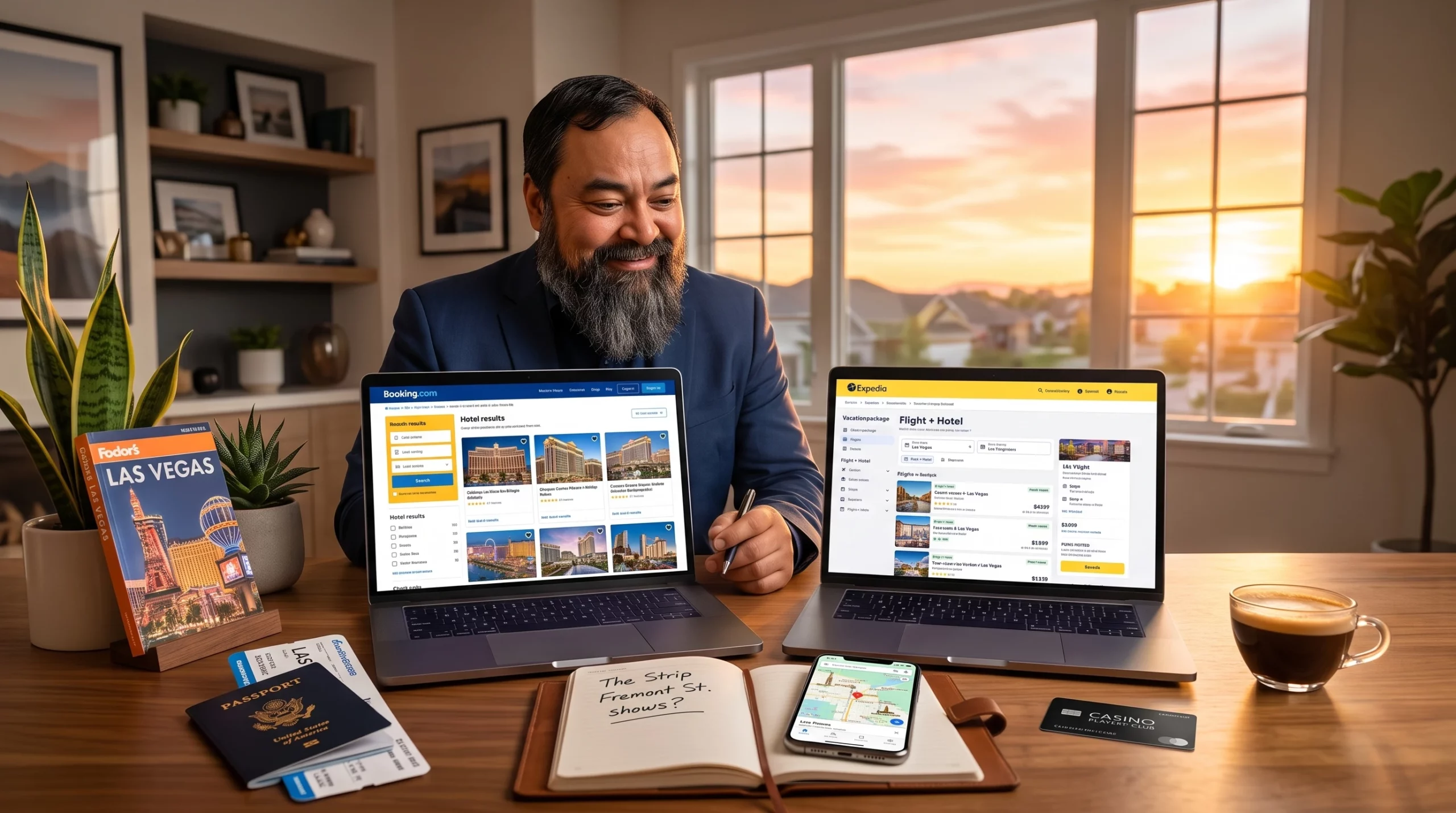
Booking.com appeared in one browser tab.
Expedia opened in another.
At first glance they looked remarkably similar. Beautiful hotel photography. Competitive prices. Countless places to stay. Filters that promised to help me narrow thousands of options into something manageable.
The longer I compared them, though, the more I realized they weren’t really trying to solve the same problem.
Booking.com seemed determined to help me find the perfect place to stay.
Expedia wanted to help me build the entire vacation.
That realization became the beginning of an interesting experiment, and by the time I finally booked my room, I understood both websites far better than I ever expected to.
Why Las Vegas Is the Perfect City for Comparing Travel Websites
Las Vegas teaches you something valuable about travel.
Never assume the first price you see is the best one.
The city is built around competition. Casinos compete for players. Restaurants compete for diners. Shows compete for audiences. Hotels compete for nearly every traveler who arrives at Harry Reid International Airport.
Room prices can change dramatically depending on the day of the week, what’s happening in town, and even how many rooms remain available.
I’ve seen hotels that were under a hundred dollars one weekend climb to several hundred dollars the next because of a convention or major sporting event. Add resort fees, parking charges, and taxes, and the nightly rate you first noticed may end up looking quite different by checkout.
That’s exactly why comparison shopping matters.
Not because one website always wins, but because each one sometimes does.
Booking.com Felt Like Browsing Neighborhoods Instead of Hotel Chains
The more time I spent exploring Booking.com, the more I noticed something that isn’t immediately obvious.
It doesn’t feel like you’re shopping for hotels.
It feels like you’re exploring destinations.
Large casino resorts certainly appear in the search results, but they’re surrounded by boutique hotels, apartment rentals, smaller independent properties, extended-stay suites, and places I probably wouldn’t have discovered otherwise.
That broader selection becomes especially useful outside Las Vegas.
When I travel internationally or visit smaller destinations, I often find accommodations on Booking.com that simply don’t appear elsewhere. Family-run inns, lakeside cottages, converted historic buildings, and unique vacation rentals all seem to have a stronger presence.
For Las Vegas, the selection is naturally dominated by casino resorts, but I still appreciated how easy it was to compare properties both on and off the Strip.
Maybe you want to stay downtown within walking distance of Fremont Street.
Maybe you’d rather wake up overlooking the Bellagio fountains.
Or perhaps your goal is simply finding a clean hotel where you’ll spend very little time because most of your vacation will happen somewhere else.
Booking.com makes that process feel surprisingly natural.
One feature that really stood out was the number of hotels offering free cancellation.
That might not sound exciting, but experienced travelers understand how valuable flexibility can be.
Flights change.
Friends decide to join the trip.
Another casino suddenly emails you a better offer.
Weather delays everything.
Life has a habit of rewriting itineraries when you least expect it.
Knowing you can adjust your plans without immediately losing your money offers a certain peace of mind that becomes more valuable the more you travel.
Expedia Thinks About the Entire Vacation
After spending time on Booking.com, switching over to Expedia almost felt like changing travel advisors.
Instead of asking me where I wanted to stay, Expedia immediately encouraged me to think about everything else.
- Did I need airfare?
- Would I need a rental car?
- Should I bundle the hotel together with my flight?
- Was I interested in activities?
It wasn’t just selling hotel rooms.
It was assembling vacations.
That approach makes a tremendous amount of sense for certain travelers.
If you’re planning a family vacation to Las Vegas, flying across the country, renting a vehicle, and staying for four or five nights, having everything organized inside one itinerary is genuinely convenient.
Even more importantly, packages can sometimes unlock savings that aren’t available when every reservation is booked separately.
That’s something many travelers overlook.
A hotel that appears slightly more expensive on its own may actually become the better overall value once it’s bundled with airfare.
It’s worth checking.
Every time.
| Feature | Booking.com | Expedia |
|---|---|---|
| Best For | Hotel-focused travelers | Complete vacation planning |
| Hotel Selection | ★★★★★ Excellent | ★★★★☆ Very Good |
| Vacation Packages | Good | ★★★★★ Excellent |
| Flights | Available | ★★★★★ Strong Selection |
| Vacation Rentals | Excellent | Very Good |
| Flexible Cancellation | Excellent | Very Good |
| Loyalty Program | Genius | One Key |
| International Travel | Excellent | Very Good |
| Las Vegas Hotel Booking | Excellent | Excellent |
| Overall Recommendation | Perfect when your hotel is the priority. | Ideal when booking your entire trip. |
Chasing the Lowest Price Doesn’t Always Save You Money
One mistake I think many travelers make is focusing entirely on the nightly room rate.
I’ve done it myself.
You see one hotel listed for fifteen dollars less than another, and your brain immediately declares it the winner.
Then reality steps in.
- Resort fees.
- Parking.
- Breakfast.
- Airport transportation.
- Cancellation policies.
- Room upgrades.
Suddenly the cheaper room isn’t actually cheaper anymore.
Las Vegas is especially good at teaching this lesson.
I’ve learned to stop asking which hotel costs less and start asking which reservation provides more value.
Sometimes spending twenty dollars more buys free cancellation, a better location, and enough reward points to reduce the cost of the next trip.
Viewed that way, it isn’t more expensive at all.
It’s simply a smarter purchase.
Rewards Programs Matter More Than Most People Realize
Both Booking.com and Expedia reward repeat customers, although they take different approaches.
Booking.com’s Genius program gradually unlocks discounts and occasional perks simply by continuing to book through the platform. You don’t have to chase complicated point systems or memorize earning charts. The benefits quietly improve as you travel.
Expedia approaches loyalty a little differently through One Key, combining rewards across Expedia, Hotels.com, and Vrbo.
If your travel habits include hotels one month, vacation rentals the next, and perhaps a weekend getaway booked through another partner, earning rewards inside a shared ecosystem can become surprisingly valuable.
Neither program convinced me to stay loyal.
But both gave me another reason to compare prices before making my final decision.
Downtown or the Strip? The Booking Website Won’t Decide That for You
One thing no booking website can answer is where you actually want to spend your vacation.
That’s your decision.
Personally, I love Downtown Las Vegas.
I’ve written before about why Fremont Street keeps pulling me back. Everything feels closer together. I enjoy the atmosphere, the live music, the history, and the fact that I can walk from casino to casino without feeling like I’ve just completed a marathon.
Someone visiting Las Vegas for the very first time might feel exactly the opposite.
They may dream about staying on the Strip with views of the fountains, luxury pools, and massive resort casinos.
Neither choice is wrong.
The important part is remembering that travel websites help you book destinations.
They don’t choose the experience for you.
Customer Service Usually Isn’t Important…Until It Suddenly Is
Most reservations happen without any problems.
- You book.
- You arrive.
- You check in.
- The vacation begins.
Customer service becomes important during the exceptions.
- A canceled flight.
- An overbooked hotel.
- A reservation that somehow disappears.
Those situations don’t happen often, but when they do, you quickly discover how important responsive support can be.
My advice is simple.
Save confirmation emails.
Take screenshots.
Double-check reservation details before leaving home.
It takes only a few minutes and can save hours of frustration later.
So Which Website Did I Choose?
After spending far more time comparing hotels than I originally intended, I finally made my reservation.
Was one website dramatically cheaper?
Not really.
Were the hotel selections radically different?
Not in Las Vegas.
What ultimately made the decision for me wasn’t a huge discount or some magical hidden deal.
It came down to which reservation fit the trip I was taking.
That’s probably the biggest lesson I learned.
There isn’t a universal winner because travelers aren’t all trying to accomplish the same thing.
If I were planning a European vacation centered around charming boutique hotels and flexible reservations, I’d probably begin with Booking.com.
If I were organizing a family vacation that included airfare, hotels, and transportation, Expedia would absolutely deserve serious consideration.
Ironically, the casino host who couldn’t find me a room ended up teaching me something far more valuable.
Never assume your first option is your best option.
The Best Travel Website Is the One That Fits Your Trip
Looking back, I’m actually glad my complimentary room wasn’t available.
Had everything gone according to plan, I probably would have accepted the reservation, packed my suitcase, and never given either website much thought.
Instead, I spent an afternoon learning how two of the biggest names in online travel actually work.
I stopped looking for a winner.
I started looking for the right tool for the job.
That’s changed how I book nearly every trip now.
Whether I’m heading back to Las Vegas, planning a weekend getaway, or exploring somewhere I’ve never been before, I almost always compare both sites before making a reservation.
Sometimes Booking.com comes out ahead.
Sometimes Expedia surprises me.
Most of the time, the winner isn’t determined by the website at all.
It’s determined by the trip you’re trying to take.
And if there’s one thing Las Vegas has taught me over the years, it’s that a little comparison shopping before you leave home often means more money left over for the experiences you’ll remember once you get there.